Archimedes' Principle states that the buoyant force that a submegred body feels is equal to the weight of the water (or fluid) that it displaces. This is a direct consequence of the fact that the pressure in a fluid varies with depth.
Consider a mass \(m\) suspended in a beaker of water with the aid of a string as shown in Fig. 1. The density of water is \(\rho_w\). The density of the mass is \( \rho_0\), and it has a volume \( V\), both of which are as yet unknown quantities.
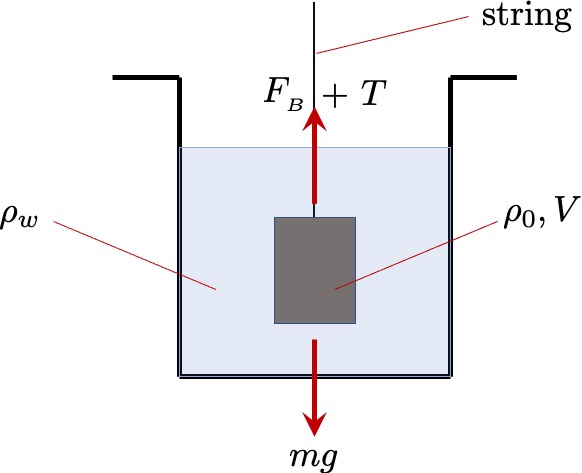
If the mass in Fig. 1 is in equilibrium then the sum of forces acting on it must be zero. Therefore we can write:
\[ F_{_B} + T = mg \label{eq:force_bal}\]
Since the density of the mass is \(\rho_0\) and the volume \(V\), we can write:
\[ \rho_0 V g = mg \label{eq:mass_weight}\]
Now, according to Archimedes's principle the buoyant force experienced by a submerged object is equal to the weight of the fluid dispersed. In Fig. 1 the volume of the fluid displaced is essentially the volume of the mass \(V\), therefore we can write:
\[ F_{_B} = \rho_w V g \label{eq:buoyant_force}\]
Substituting Eqs. \eqref{eq:mass_weight} and \eqref{eq:buoyant_force} into Eq. \eqref{eq:force_bal} we get:
\[ \rho_w V g + T = \rho_0 V g \label{eq:force_bal2}\]
If we are able to measure the tension (\(T\)) in the string somehow as well as determine the unknown value for the volume (\(V\)) then we can determine the unknown density \(\rho_0\)
If you would like to learn more about buoyancy and Archimedes' Principle, see the following video.
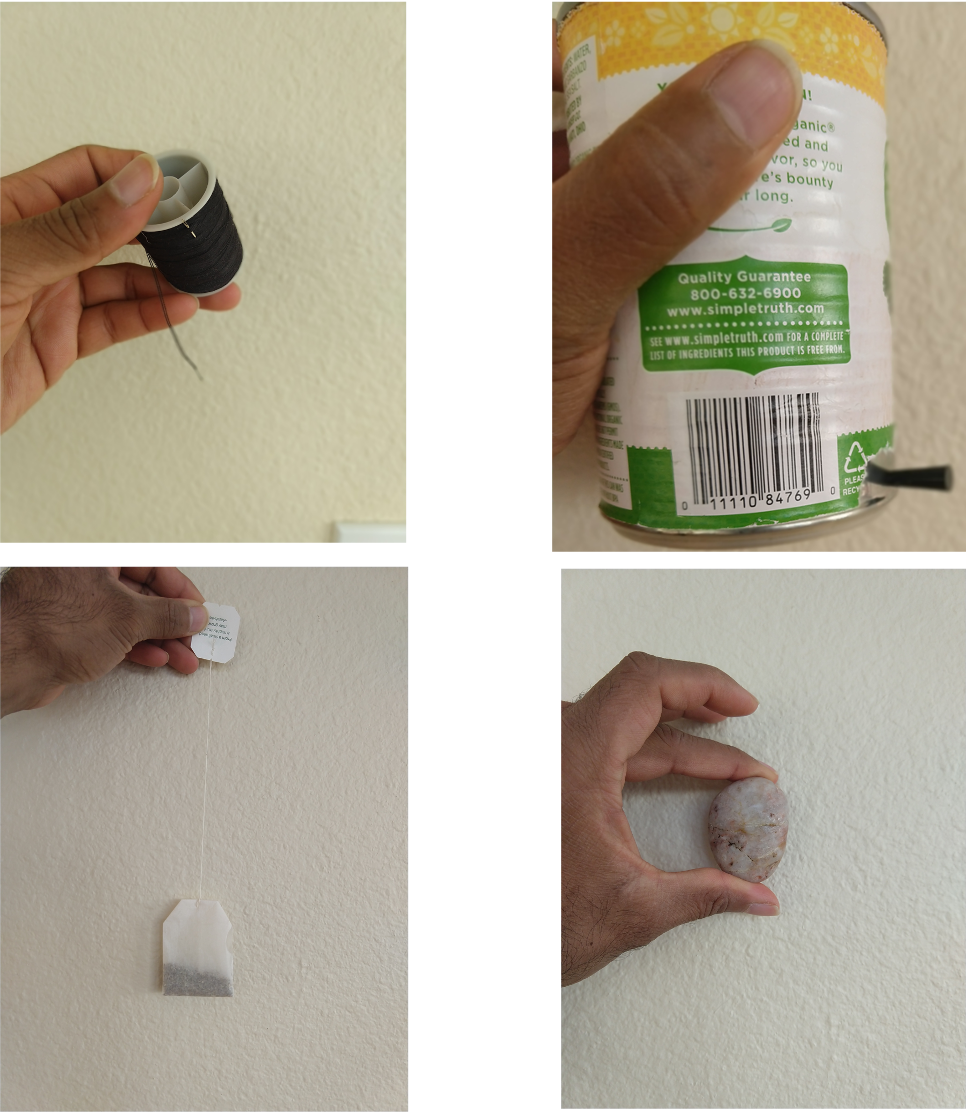
For carrying out the experiment you will need the following equipment (see Fig. 2):
Please note: DO NOT disassemble the apparatus once you have put it together as you will need the same apparatus for Lab No. 2 for the Bernoulli's Equation Lab.
The procedure to be followed for doing the experiment is given below:
The following video shows how to analyse the collected data for determining the string tension when buoyancy is absent:
When the pebble is simply suspended then the tension in the string, which is the reading from the force sensor, is equal to the weight of the pebble. We can write:
Currently, both the volume (\(V\)) and the density (\(\rho_0\)) are unknown.
Figure 7 below shows how to determine the average value of the tension in the string by selecting the appropriate portion of the data from the force sensor reading:
The following video shows how to analyse the collected data for determining the string tension when buoyancy is present:
Figure 8 below shows how to select the force sensor data when the pebble is submerged in the water:
Now that we have determined the string tension when the buoyant force is both present and absent, we are in a position now to determine both the unknown density (\(\rho_0\)) and the unknown volume (\(V\)) of the pebble. Let us first rewrite Eq. \eqref{eq:Tprime} and Eq. \eqref{eq:force_bal2} below:
\[\rho_w V g + T = \rho_0 V g \label{eq:force_bal_again}\]
\[T^\prime = \rho_0 V g \label{eq:Tprime_again}\]
Substituting Eq. \eqref{eq:Tprime_again} into Eq. \eqref{eq:force_bal_again} we can solve for the volume (\(V\)) as:
\[V = \frac{T^\prime - T}{g\rho_w} \label{eq:vol}\]
In order to calculate the volume use \(g=9.8~\textrm{m/s}^2\). We can now determine the density by substituting Eq. \eqref{eq:vol} into Eq. \eqref{eq:Tprime_again} and solving for the density (\(\rho_0\)):
\[T^\prime = g\rho_0 \frac{T^\prime - T}{g \rho_w}\]
\[\implies \rho_0 = \rho_w \left( \frac{T^\prime}{T^\prime - T}\right)\]
In order to calculate the density of the pebble, use \(\rho_w = 1000~\textrm{kg/m}^3\).
Make sure you include the following in your lab report: