Physics Overview
The force of friction is a necessary evil - we can't live without it; for example without friction you wouldn't be able to walk on any surface. And during motion, it dissipates energy from the system, therefore work needs to be done to overcome its effect.
Consider the following scenario. A block of mass \(m\) rests on a horizontal surface as shown in Figure 1. There are numerous forces acting on it, one of which is an applied force to the right. In the vertical direction the normal force counteracts the weight of the object, exactly, hence the two are equal in magnitude and opposite in direction. The surface has friction which is a contact force that opposes the motion of the block. Hence, as can be seen in Figure 1, the direction of the friction force is opposite to the motion, which is depicted by the direction of the block's acceleration.
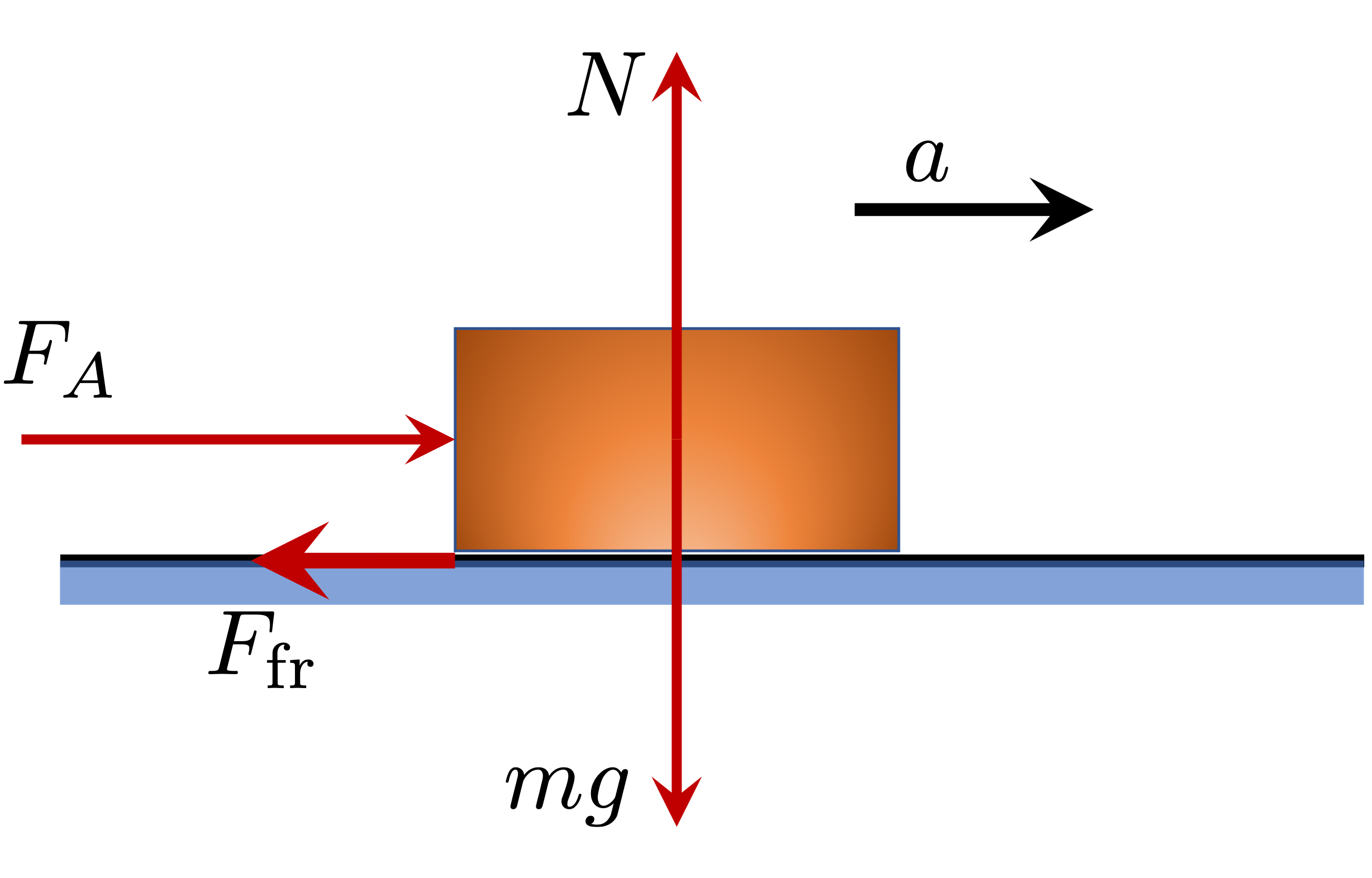
Therefore we can infer from the free body diagram that the net force on the object is in the \(x-\)direction since the forces in the \(y-\)direction are balanced. Therefore we can write using Newton's Laws of motion:
\[ N = mg, \label{eq:normal_force}\]
and
\[ ma = F_A - F_{\textrm{fr}} \label{eq:net_force}\]
Now, the force of friction is proportional to the normal force and the constant of proportionality is called the coefficient of friction,
\[ F_{\textrm{fr}} \propto N \implies F_{\textrm{fr}} = \mu N,\label{eq:fr1}\]
where \(\mu\) is the coefficient of friction; for a static situation (\(a=0\) in Eq. \eqref{eq:net_force}) it is \(\mu_s\), and for a kinetic situation it is \(\mu_k\).
The situation shown in Figure 1 is a kinetic situation as the block has an acceleration to the right. (The block will only move once the applied force exceeds the maximum force of static friction.) Hence we will assume that the coefficient of kinetic friction between the block and the surface is \(\mu_k\).
Substituting for the friction in Eq. \eqref{eq:net_force} we get,
\[ ma = F_A - \mu_k mg, \label{eq:a1}\]
and hence we can immediately get an expression for the acceleration as,
\[ a = \frac{F_A}{m} - \mu_k g, \label{eq:a2}\]
Note that the coefficients of friction, both kinetic and static, are particular for the surfaces in question. Thus, placing the same block shown in Figure 1 on a different surface you will have different coefficients for static and kinetic friction between the block and the surface.
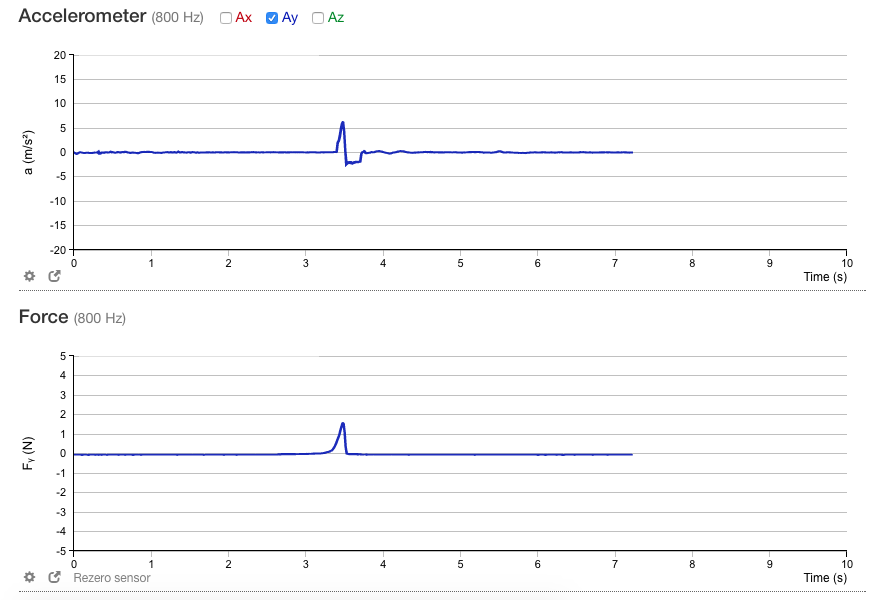
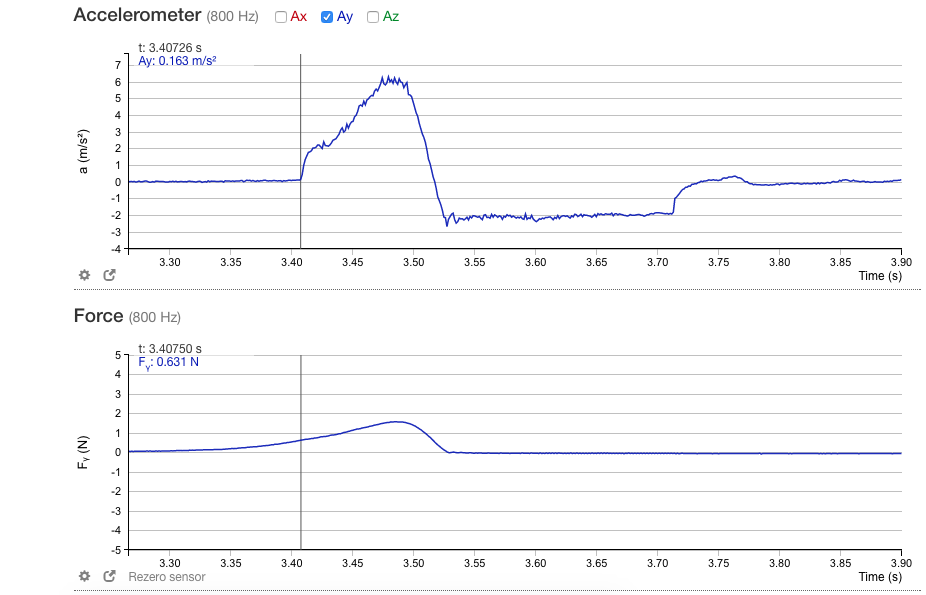
Now let us consider a slightly different scenario as shown in Figure 2.
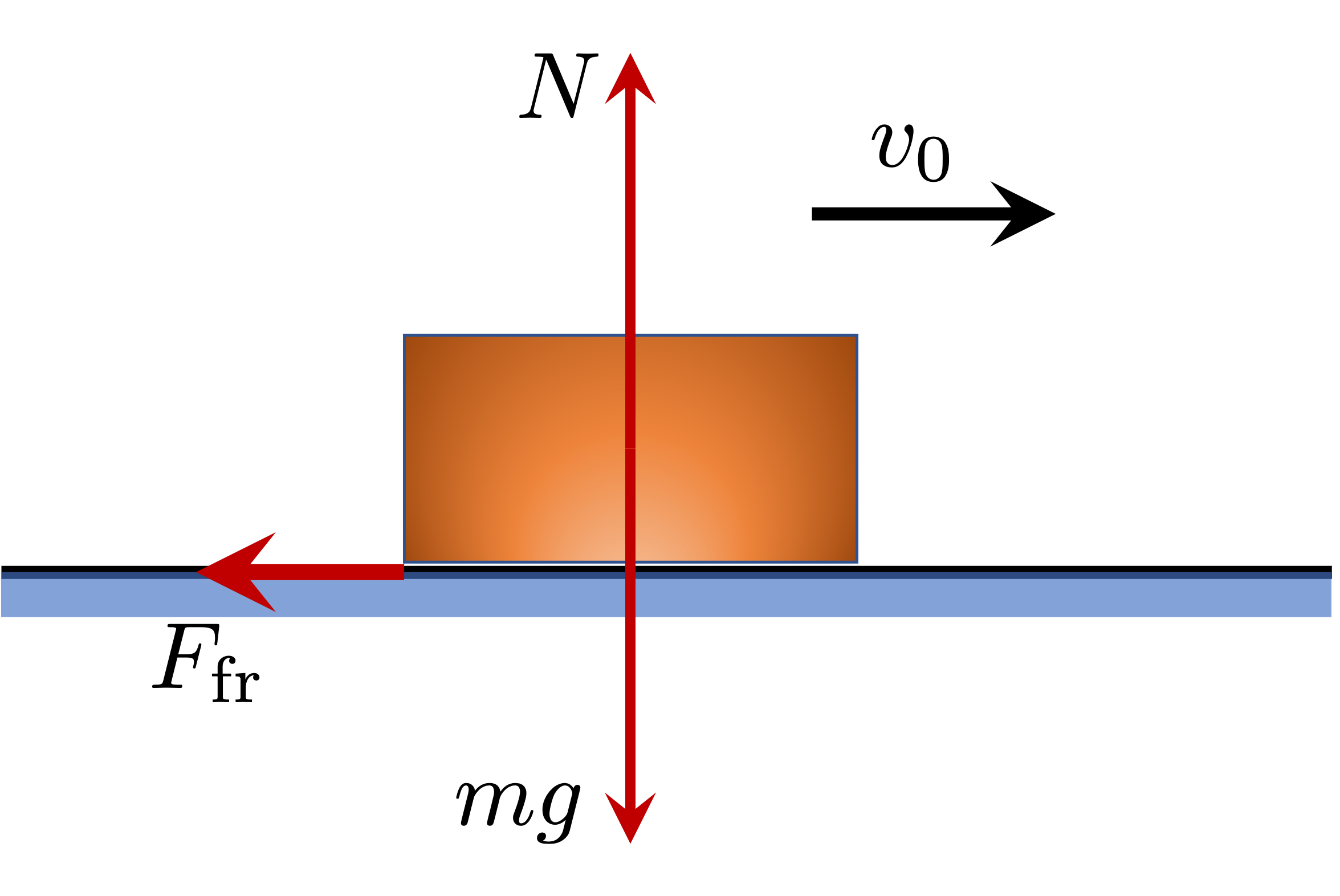
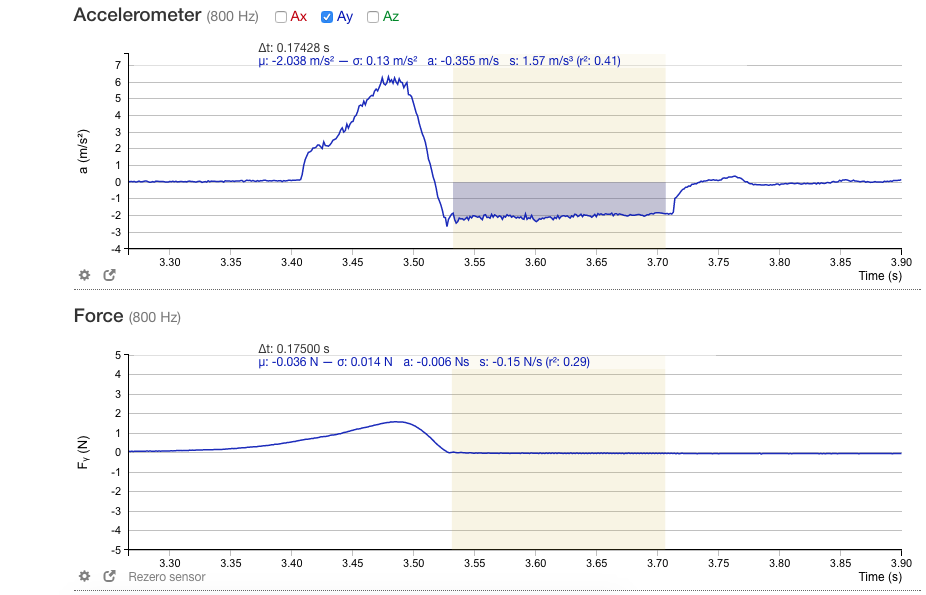
This scenario is a little simpler to analyse as the mass is acted upon by a constant force - namely, the force of friction that slows it down. The net force on the block is simply the force of friction. Therefore we can write,
\[ F_{\textrm{net}} = F_{\textrm{fr}} \implies ma = \mu_k mg,\label{eq:onlyfr}\]
which immediately yields,
\[ a = \mu_k g.\label{eq:a3}\]
Thus, if the acceleration of the block due to friction could be measured then the coefficient of kinetic friction can be obtained as,
\[ \mu_k = \frac{a}{g}. \label{eq:muk} \]
This is what you will be doing in today's lab.
If you would like to learn more about friction, see the following video.